Understanding tourism involves more than discovering destinations and attractions. Behind every destination are operational systems, logistics, coordination, and governance that shape how tourism activities are managed and how visitors experience a place.
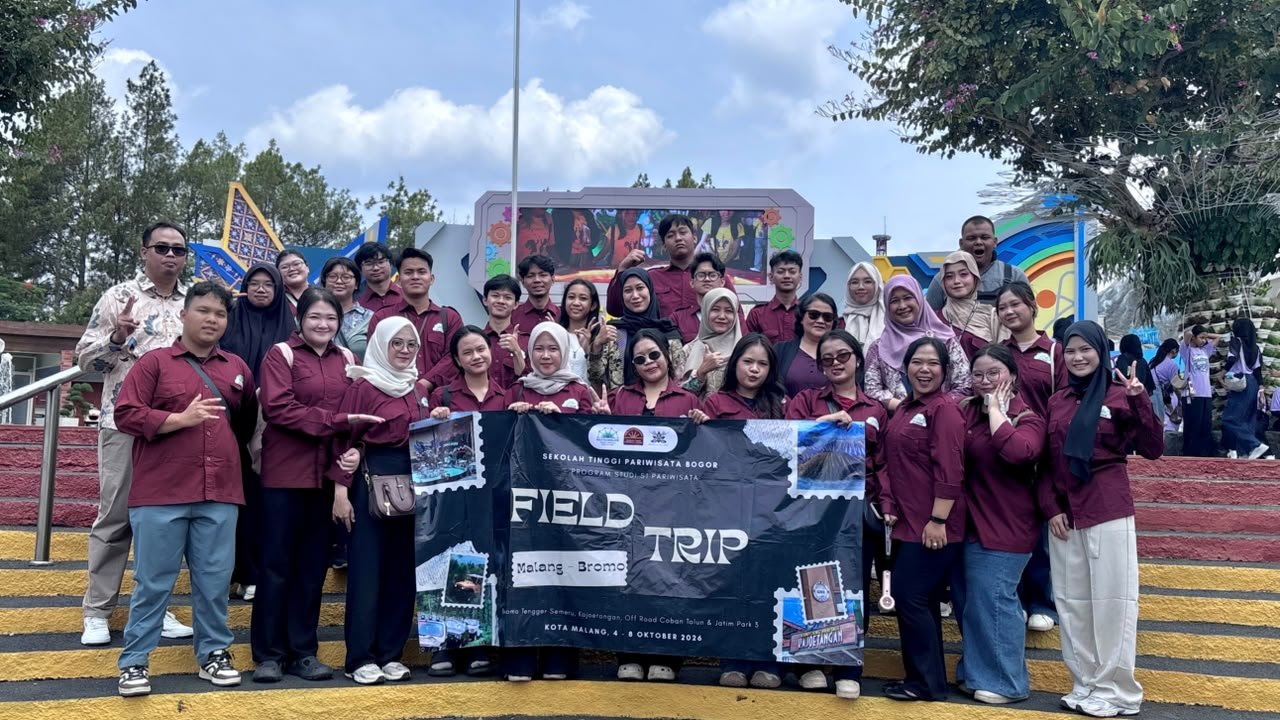
These aspects became part of the learning experience for students of the Bachelor of Tourism Study Program at Sekolah Tinggi Pariwisata (STP) Bogor through a field trip to Malang, East Java, from October 4–8, 2026.
The program involved 24 active fifth-semester Tourism students from Batches 50 and 51, accompanied by several STP Bogor lecturers. The five-day journey was designed as an experiential learning activity, connecting academic knowledge with real-world observations. Malang was selected for its diverse tourism destinations, providing students with opportunities to examine tourism management from different perspectives.
Throughout the five-day trip, students participated in activities and visits to destinations offering different types of tourism experiences. The itinerary included an off-road adventure at Coban Talun, a visit to Pasar Klojen, a sunrise experience at Mount Bromo via the Sukapura route, and an exploration of the historic Kayutangan area.
These destinations offered students exposure to a range of tourism characteristics, from nature-based tourism and adventure activities to urban tourism, heritage areas, and locally based tourism products.
The field trip was designed not simply as a journey to visit tourist attractions, but as a learning experience that encourages students to observe, analyze, and understand destination operations firsthand.
Through field observation, students are expected to strengthen their critical thinking skills in examining operational challenges, risk management, logistics, and tourism governance.
These experiences also provide perspectives on the challenges destinations may face when managing tourism activities, serving visitors, and coordinating different operational requirements.
As a result, students are encouraged to look beyond the perspective of tourists and begin examining destinations as future tourism professionals who need to understand how tourism activities are planned and managed.
Through the field trip to Malang, STP Bogor provided students with an opportunity to broaden their perspectives while developing competencies relevant to the tourism industry.
Experiential learning complements academic instruction by allowing students to connect theoretical concepts with destination conditions, recognize real-world challenges, and understand how tourism management requires a combination of knowledge, analytical skills, communication, and teamwork.
Ultimately, tourism education is not only about introducing students to destinations. It is also about developing their ability to understand, evaluate, and contribute to destination development.
By combining classroom learning with direct field experience, STP Bogor continues to encourage students to prepare for professional careers in tourism with critical thinking, adaptability, and a deeper understanding of industry dynamics.
For prospective students interested in destination management, the travel industry, and tourism development, experiences like this demonstrate how academic knowledge can be enriched through observation and real-world learning.