How hard can it be to make a bed?
The question tends to arise whenever people see a neatly arranged hotel room. Since nearly everyone has tidied up their own bed at some point, the skill is often dismissed as trivial. That perception changes completely inside a competition arena. The stopwatch is running, judges circle the bed, their eyes search for a single crease in the sheet, and their hands check the sharpness of every fold at the corners. In that setting, bed making is no longer a household chore, but a discipline of precision that demands accuracy, speed, and composure at the highest level.
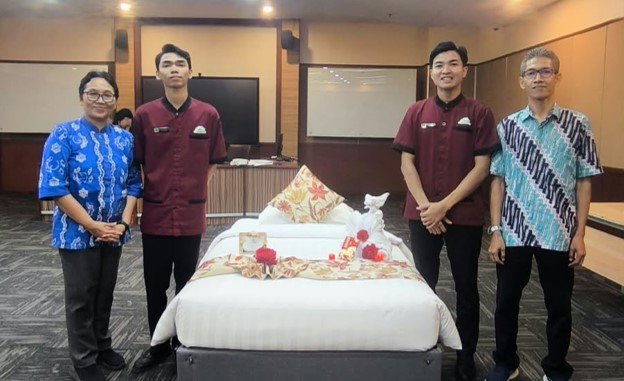
It is from such an arena that encouraging news has arrived for Sekolah Tinggi Pariwisata (STP) Bogor. At Hospartation 2026, hosted by Universitas Bunda Mulia, two students from the D4 Hotel Management program of STP Bogor secured podium finishes in the Making Bed Competition. Nanda Deo Atana took second place while Muhamad Ade Ardiansyah claimed third. Earning two podium spots in a single category is no accident, as it signals a campus learning system that works, built on deep hands-on practice, clear standards, and mentorship from lecturers who truly master their field.
To appreciate the weight of this achievement, one must first understand the field in which these skills are forged, namely housekeeping. Housekeeping is the hotel department responsible for the cleanliness, order, comfort, and aesthetics of guest rooms and public areas. It is often described as the silent heart of a hotel because it rarely appears on the front stage, yet it shapes the very first impression guests receive when they open their room door and influences their decision to return. Within housekeeping, two skills stand out as the most iconic, namely Making Bed and Towel Art. Towel Art is the craft of folding and shaping towels into decorative forms such as swans, elephants, or flowers to create a memorable touch for guests. Making Bed, in turn, is the process of preparing a bed to hotel standards, from taut and wrinkle-free sheets to crisp folds and perfect symmetry.
At home, making a bed takes only a few minutes and nobody inspects the result, so it is easy to see why many regard it as simple. In the hotel world and in competition arenas, the story is entirely different. Sheets must be stretched as taut as a drum surface, because a tiny crease invisible to the untrained eye becomes a deduction in the eyes of the judges. The folds at the corners of the bed, known as hospital corners, must be sharp and identical on every side, leaving no room for careless work. The drape of the blanket on the left and right must balance down to the centimeter, and in competition the judges do not hesitate to measure it directly. Beyond accuracy, there is also the pressure of time, because in the workplace a room attendant operates under a strict target for every room. Speed and precision, which often pull in opposite directions, must be present at the same time. Tucking linen beneath a heavy mattress also requires correct body mechanics, since a flawed technique produces inconsistent results and quick fatigue. Making one bed perfectly may happen by luck, but making hundreds of beds perfectly under any condition is a craft born only from hundreds of repetitions. For that reason, Making Bed is often compared with the knife skills of a professional chef, in that it looks simple from the outside while the level of mastery is evident from a single finished result.
Such mastery is not built through chalkboard explanations alone, and this is where the learning approach of STP Bogor plays its part. As a higher education institution that emphasizes vocational education through its one-year, D3, and D4 tracks, STP Bogor applies a composition of 70 percent practice and 30 percent classroom learning. With this composition, skills such as Making Bed and Towel Art are not merely understood in theory but trained until they settle into muscle memory. Students repeat the techniques over and over against real hotel standards, complete with the demands of speed and consistency found in the industry. The classroom provides the understanding behind every procedure, while the practical space provides the opportunity to master the craft in full.
This reliability also does not form on its own. Behind the students who train stands a guiding figure, Mrs. Diah Renata Anggraeni, S.Tr.Par., M.M., a lecturer at STP Bogor who is affectionately known as Mam Reni. With an educational background spanning applied tourism studies through to a master's degree in management, Mam Reni ensures the reliability of students in housekeeping, so that they are not merely able to perform the work but do so accurately, swiftly, consistently, and with a professional working character. This combination of technical skill and mental formation is what allows STP Bogor students to appear not only as participants but also as champions.Winning in a competition arena certainly proves mental resilience and technical precision under the pressure of judges.
The victories of Nanda Deo Atana and Muhamad Ade Ardiansyah in the competition scene, thus serve as a firm conclusion to this entire chain of proof. These consecutive achievements are not the product of chance but the direct result of a learning method that places practice at its core, of mentorship from lecturers who master their field, and of repeated training that turns precision into habit. If a skill as often underestimated as making a bed can carry STP Bogor students onto the winners' podium and earn recognition from luxury hotels, one conclusion can be drawn clearly. That conclusion is that at this campus excellence is not merely promised but trained, tested, and proven in reality.
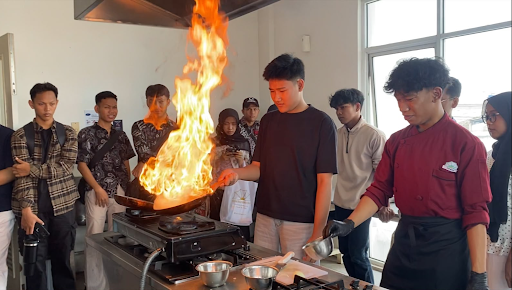
STP Bogor Open House 2026 Draws a Lively Crowd as an STP Bogor Alumnae at Swiss Belhotel Bogor Shares Her Story
Bogor, 3 October 2026 - Sekolah Tinggi Pariwisata (STP) Bogor once again welcomed prospective students and the public to its campus for an Open House on Saturday, October 3, 2026. The interactive event offered a first-hand look at student life, campus facilities, and career prospects in the hospitality industry.
Read more